
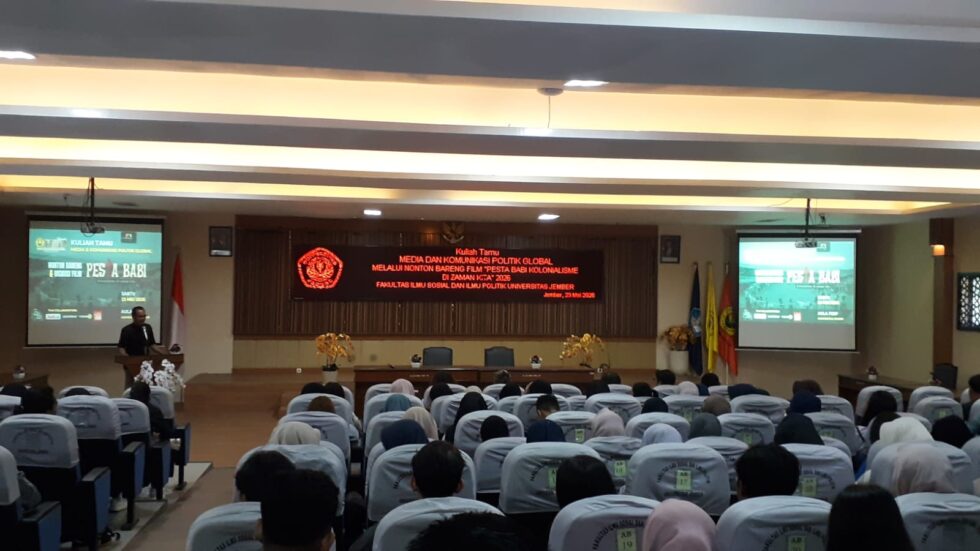
The auditorium of the Faculty of Social and Political Sciences (FISIP) at the University of Jember transformed into a space for critical discussion on Saturday (23/05/2026) during a guest lecture themed “Global Media and Political Communication.” The event featured a collective screening of a documentary film titled The Colonial Pig Feast in Our Time 2026. Packed with students and lecturers, the event invited a prominent keynote speaker to delve into the topic. Through the film screening—which dissects contemporary economic and cultural colonialism—participants were urged to understand how global mass media plays a role in perpetuating unequal power relations between nations.
The film The Colonial Pig Feast in Our Time 2026 presents a powerful allegory of the exploitation of natural resources and labor in the Global South, neatly wrapped in narratives of development and investment. Set in a science-fiction world in the year 2026, the film depicts a massive “feast” celebrated by transnational corporations and global political elites, while local communities bear the brunt of ecological and social crises. Throughout the screening, the audience remained silent, closely observing every scene that highlighted the role of social media, digital algorithms, and cross-border political campaigns in normalizing structural inequality.
During the post-screening discussion session, the keynote speaker emphasized that current global political communication is inseparable from colonial legacies, which continue to be reproduced through media framing.
“This film demonstrates how the ‘pig feast’ takes place in our daily digital spaces—through advertisements, biased news, and politician endorsements by corporate giants,” they remarked.
The speaker also highlighted the urgent need for critical media literacy among the younger generation to dismantle hidden messages that sustain global injustice. Students enthusiastically raised questions regarding alternative communication resistance, such as citizen media movements and data journalism from a Southern perspective.
Meanwhile, the Chairperson of the Guest Lecture Organizing Committee explained that the collective screening method was chosen to make the abstract issues of global political communication more relatable through visual and emotional experiences.
“Theories on hegemony and cultural imperialism often feel heavy if only taught through conventional lectures. Through this film, students can directly perceive how power mechanisms operate cinematics,” they explained. They added that participant enthusiasm exceeded their initial target, with a total of 150 students from various faculties in attendance.