
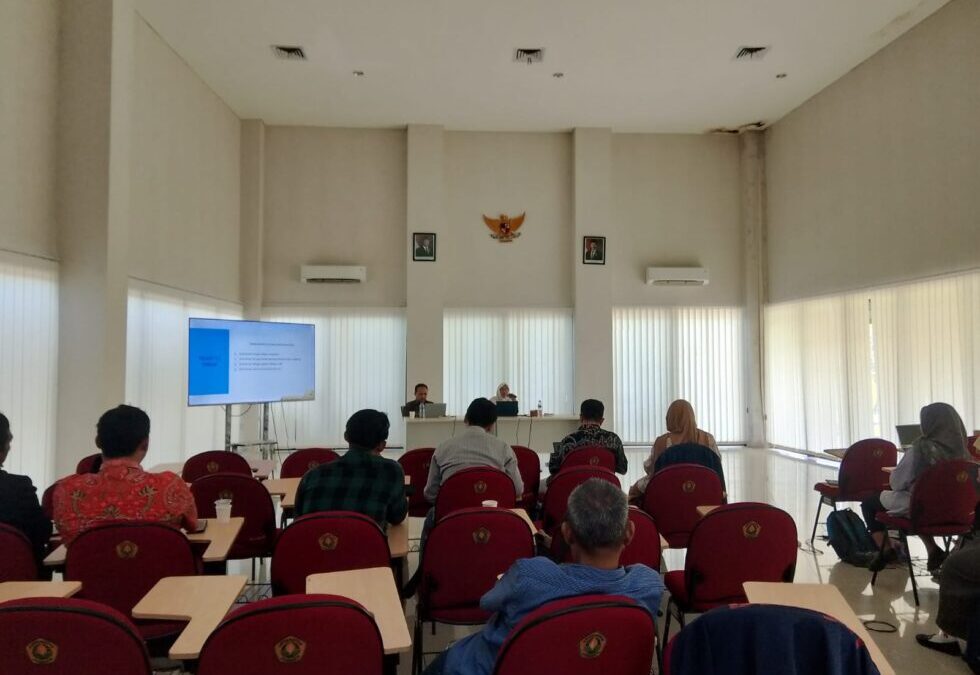
The Faculty of Social and Political Sciences (FISIP) at the University of Jember (UNEJ) convened a comprehensive one-day workshop on Saturday, April 4, 2026, dedicated to restructuring the Laboratory of Public and Business Administration Technology (LATABP). Held at the Economics Room 1 of UNEJ’s Jubung Vocational Campus, the strategic initiative aimed to realign the laboratory’s governance framework to ensure greater adaptability toward rapid technological advancements and evolving industry demands. In her opening remarks, the Dean of FISIP UNEJ, Suyani Indriastuti, S.Sos., M.Si., Ph.D., emphasized that the restructuring is a pivotal step toward producing highly competitive graduates in the digital era. She envisioned the facility evolving beyond a conventional practical space into an integrated hub for innovation and research.
The workshop brought together key academic stakeholders, including heads of study programs, laboratory directors, faculty members, and administrative staff within FISIP UNEJ. The agenda focused on three core areas: developing technological infrastructure, designing project-based practicum curricula, and enhancing the professional capacity of laboratory management personnel. Dr. Ike Wanusmawatie, S.Sos., M.AP., Head of the Laboratory at the Faculty of Administrative Sciences, Universitas Brawijaya, served as the keynote speaker. She highlighted that the restructuring would primarily target the digitalization of administrative systems and strengthen collaborative networks with industry partners. The session sparked interactive discussions, with participants actively contributing insights regarding the need for policy simulation and business management software.
A primary objective of the workshop was aligning laboratory activities with the professional competence standards required by both the corporate sector and government institutions, rendering professional certification for lab managers and assistants an absolute necessity. LATABP, which has long supported students of Business Administration and Public Administration, will be revitalized into a technology-driven training and certification center. The Vice Dean III of FISIP UNEJ added that the outcomes of this restructuring would be seamlessly integrated into the new curriculum set for implementation in 2026. This integration ensures that students will not only absorb theoretical knowledge but also immediately apply it through real-world simulations and case studies.
Beyond technical upgrades, the workshop formulated human resource development schemes through internship programs and collaborative research opportunities for lecturers and laboratory staff. Participants agreed to establish a dedicated working group tasked with drafting the LATABP restructuring blueprint over the next three months, aiming for national accreditation and positioning the facility as a benchmark for other faculties within UNEJ. Dean Indriastuti highly commended the academic community’s shared commitment to continuous improvement to elevate the standards of higher education.
With the successful conclusion of this workshop, FISIP UNEJ remains optimistic about fostering graduates who possess not only academic excellence but also high employability and practical skills tailored for the Industrial Revolution 5.0. Ultimately, the LATABP restructuring is expected to serve as a blueprint for laboratory management across higher education institutions in Indonesia. The event concluded with the signing of a joint commitment by all participants to ensure the sustainable and continuous implementation of the workshop’s outcomes, further solidifying FISIP UNEJ’s position as an impactful and adaptive institution.