
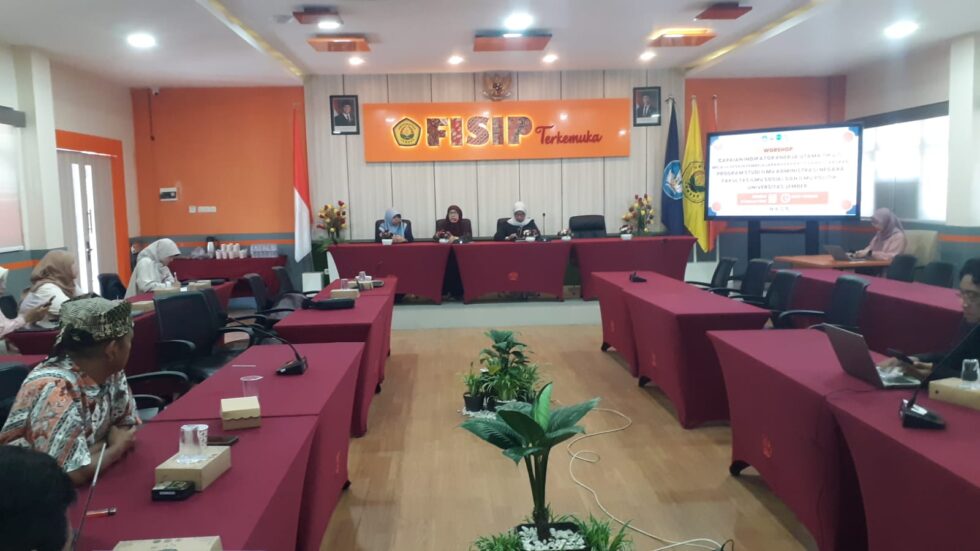
The Public Administration Study Program at the Faculty of Social and Political Sciences (FISIP), University of Jember, conducted an intensive workshop titled “Achieving Key Performance Indicator (IKU 7) Through Participatory and Collaborative Learning Design” on Wednesday, February 11, 2026. Held in the International Room, the event was well-attended by the study program’s faculty members.
The workshop was officially opened by the Dean of FISIP UNEJ, Suyani Indriastuti, M.Si., Ph.D. In her opening remarks, she emphasized the critical need to transform classroom learning methodologies to meet national higher education quality standards. Accompanied by Dr. Dina Suryani, S.Sos., M.Si., Head of the Department of Administrative Sciences and Coordinator of the Public Administration Study Program, the Dean oversaw technical discussions aimed at developing a more adaptive instructional framework.
The primary focus of the workshop was to dissect strategies for achieving IKU 7, which specifically measures participatory and collaborative classroom environments. Faculty members were encouraged to reformulate conventional teaching methods into more dynamic approaches. This shift is expected to cultivate an academic ecosystem where students actively engage in problem-solving and teamwork.
The Dean of FISIP, Suyani Indriastuti, further explained that the outcomes of this initiative are highly measurable and crucial for both institutional accreditation and graduate quality. “Our targeted end results include a comprehensive Monitoring and Evaluation (MONEV) report on instructional tools, alongside the formulation of an updated Semester Learning Plan (RPS),” she stated during the event.
Furthermore, the newly drafted RPS is now mandated to be anchored in the Case Method and Outcome-Based Education (OBE). Through the implementation of this design, the curriculum of the Public Administration Study Program is projected to effectively address contemporary workforce challenges by honing students’ critical analysis skills through real-world case studies and a clear, results-oriented learning framework.